Money · worksheet · PR55
Paycheque budget
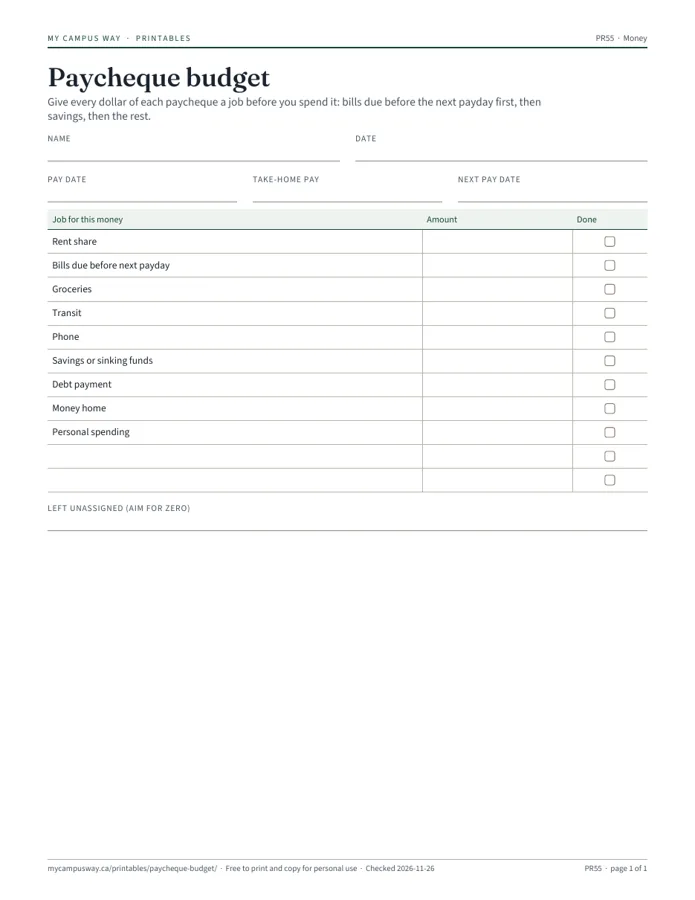
Give every dollar of each paycheque a job before you spend it: bills due before the next payday first, then savings, then the rest.
Online companions in the toolkit: Paycheque budget: which pay covers which bill (TK342) · Pay stub decoder: does gross minus deductions equal net? (TK448) · Tip-out calculator for servers and bartenders (TK449).
Download
- PDF, US Letter (fillable) · 47 KB
- PDF, A4 (fillable) · 48 KB
- Word (.docx), editable · 38 KB
- Excel (.xlsx), editable · 6 KB
The PDFs have fill-in boxes you can type into in a PDF reader, or print and write by hand. Both sizes print without scaling. The Word and Excel files are yours to change. Nothing is sent to us.
How to use it
- Use take-home pay from the pay stub, not the hourly rate.
- Cover what's due before the next payday first.
- Pay savings next, then everything else.
- Aim for zero unassigned: every dollar has a job.
What's on the sheet
Fill in
- Pay date
- Take-home pay
- Next pay date
Table
- Columns: Job for this money, Amount, Done
- Rows: Rent share, Bills due before next payday, Groceries, Transit, Phone, Savings or sinking funds, Debt payment, Money home, Personal spending
Fill in
- Left unassigned (aim for zero)
Prefer to type the numbers in? Paycheque budget: which pay covers which bill (online calculator) · Pay stub decoder: does gross minus deductions equal net? (online calculator) · Tip-out calculator for servers and bartenders (online calculator)