Tax residency: follow the flowchart
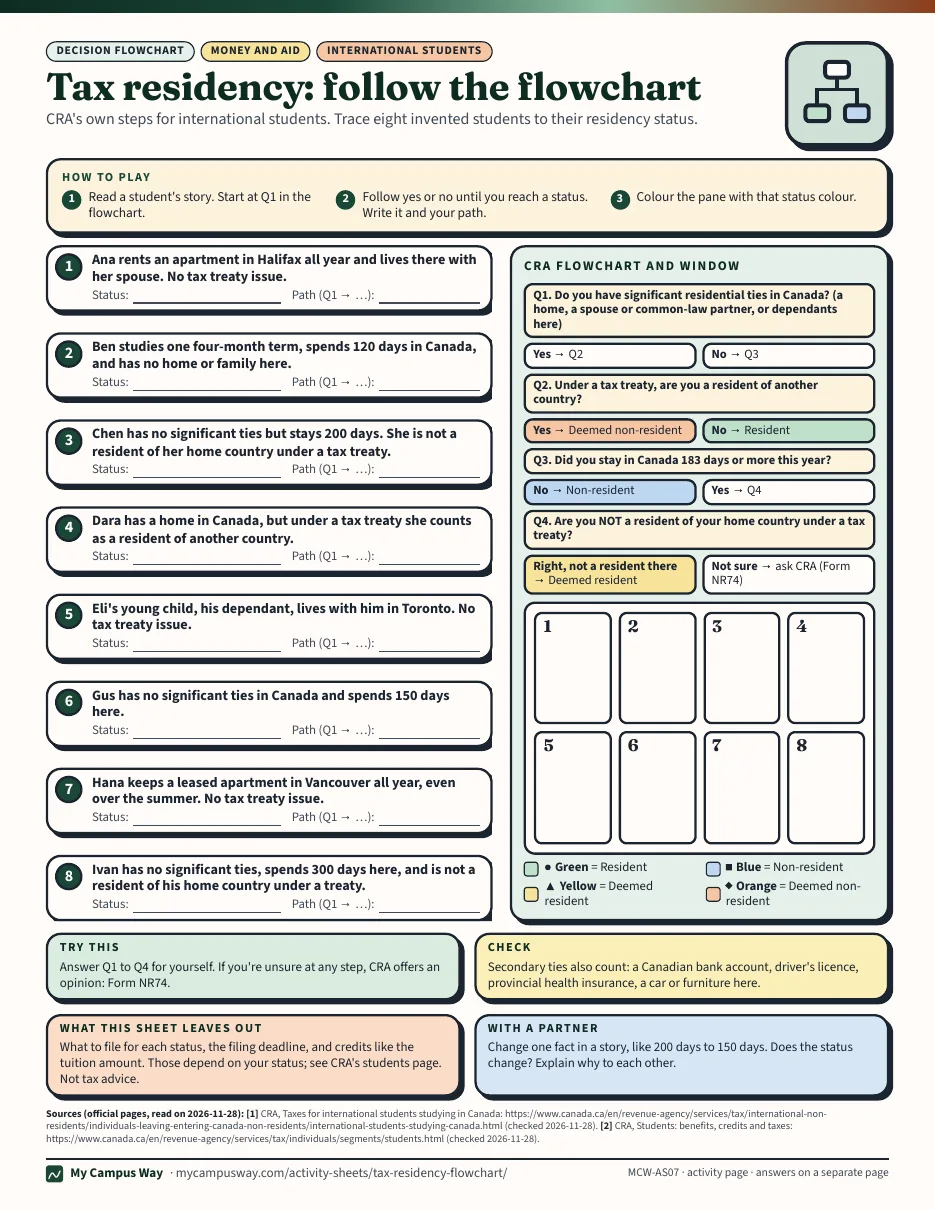
CRA's own steps for international students. Trace eight invented students to their residency status.
For: International. Where: All provinces (federal CRA rules). MCW-AS07.
Print it
- Activity sheet, PDF (US Letter) · 100 KB
- Answer key, PDF (US Letter, separate page) · 85 KB
- Answer key on the web
Prints without scaling. Works in black and white: every colour also has a name and a symbol. Free to print and share in class.
How to play
- 1Read a student's story. Start at Q1 in the flowchart.
- 2Follow yes or no until you reach a status. Write it and your path.
- 3Colour the pane with that status colour.
The sheet
Ana rents an apartment in Halifax all year and lives there with her spouse. No tax treaty issue.
Status:Path (Q1 → …):
Ben studies one four-month term, spends 120 days in Canada, and has no home or family here.
Status:Path (Q1 → …):
Chen has no significant ties but stays 200 days. She is not a resident of her home country under a tax treaty.
Status:Path (Q1 → …):
Dara has a home in Canada, but under a tax treaty she counts as a resident of another country.
Status:Path (Q1 → …):
Eli's young child, his dependant, lives with him in Toronto. No tax treaty issue.
Status:Path (Q1 → …):
Gus has no significant ties in Canada and spends 150 days here.
Status:Path (Q1 → …):
Hana keeps a leased apartment in Vancouver all year, even over the summer. No tax treaty issue.
Status:Path (Q1 → …):
Ivan has no significant ties, spends 300 days here, and is not a resident of his home country under a treaty.
Status:Path (Q1 → …):
CRA flowchart and window
Q1. Do you have significant residential ties in Canada? (a home, a spouse or common-law partner, or dependants here)
Yes → Q2
No → Q3
Q2. Under a tax treaty, are you a resident of another country?
Yes → Deemed non-resident ◆
No → Resident ●
Q3. Did you stay in Canada 183 days or more this year?
No → Non-resident ■
Yes → Q4
Q4. Are you NOT a resident of your home country under a tax treaty?
Right, not a resident there → Deemed resident ▲
Not sure → ask CRA (Form NR74)
- 1
- 2
- 3
- 4
- 5
- 6
- 7
- 8
- ● Green = Resident
- ■ Blue = Non-resident
- ▲ Yellow = Deemed resident
- ◆ Orange = Deemed non-resident
Try this
Answer Q1 to Q4 for yourself. If you're unsure at any step, CRA offers an opinion: Form NR74.
Check
Secondary ties also count: a Canadian bank account, driver's licence, provincial health insurance, a car or furniture here.
What this sheet leaves out
What to file for each status, the filing deadline, and credits like the tuition amount. Those depend on your status; see CRA's students page. Not tax advice.
With a partner
Change one fact in a story, like 200 days to 150 days. Does the status change? Explain why to each other.
Sources
- CRA, Taxes for international students studying in Canada: https://www.canada.ca/en/revenue-agency/services/tax/international-non-residents/individuals-leaving-entering-canada-non-residents/international-students-studying-canada.html · checked 2026-11-28
- CRA, Students: benefits, credits and taxes: https://www.canada.ca/en/revenue-agency/services/tax/individuals/segments/students.html · checked 2026-11-28
Names, letters, messages and amounts marked as invented are made up for practice. This is classroom review, not legal, tax or immigration advice. For immigration we give IRCC's facts and links only.